Article content
I usually photograph places after they have grown quiet. In Finland, that often means returning at dawn, waiting for mist or staying after a road has emptied. I can give the landscape time and respond to whatever the weather brings.
India offered almost the opposite conditions. This was an official group journey built around cultural and historical sites, with a fixed programme and many visits taking place in the middle of the day. I could not wait for the light, return when the weather changed or spend several hours getting to know one location.
Instead, I began to look for shorter observations: someone crossing a courtyard, two men moving beneath an old tree, a dog standing in water or a farmer guiding oxen through red soil.
From 26 June to 5 July 2026, I travelled through India as part of a familiarisation visit organised and hosted by the Ministry of External Affairs, Government of India. Our route included New Delhi, Agra, Hampi, Anegundi and Bengaluru. This photo essay follows the part of the journey I photographed most closely.
No short visit can explain a country as large and varied as India. These photographs are not intended to define it. They form a personal sequence of places, people and small scenes that stayed with me.
The scale of arrival
New Delhi first appeared to me through distance and scale. Along Kartavya Path, the road, lamps and formal buildings seemed to continue towards the horizon. People moved through the scene in small groups while evening light broke through heavy clouds above them.
The surroundings were carefully planned, but the changing weather prevented them from feeling completely fixed. For a few minutes, the light softened the formality of the avenue and gave the people walking through it a stronger presence.
Agra brought a different kind of scale.
The Taj Mahal is not a palace, but a mausoleum commissioned in the 17th century by the Mughal emperor Shah Jahan for his wife Mumtaz Mahal. Its white marble, gardens and exact symmetry are often discussed through beauty and love, but the building also carries ideas of grief, memory and imperial power.
It is one of the most photographed buildings in the world. Before lifting my camera, I was conscious of all the images that already existed.
I did not feel that the familiar viewpoints needed to be avoided simply because they had been photographed many times. Some places invite experimentation and unexpected angles. At the Taj Mahal, the symmetry and architectural design are central to the experience. The long garden, reflecting pool, gateways and mausoleum were created as one composition, and there is value in seeing and photographing that composition as it was intended.
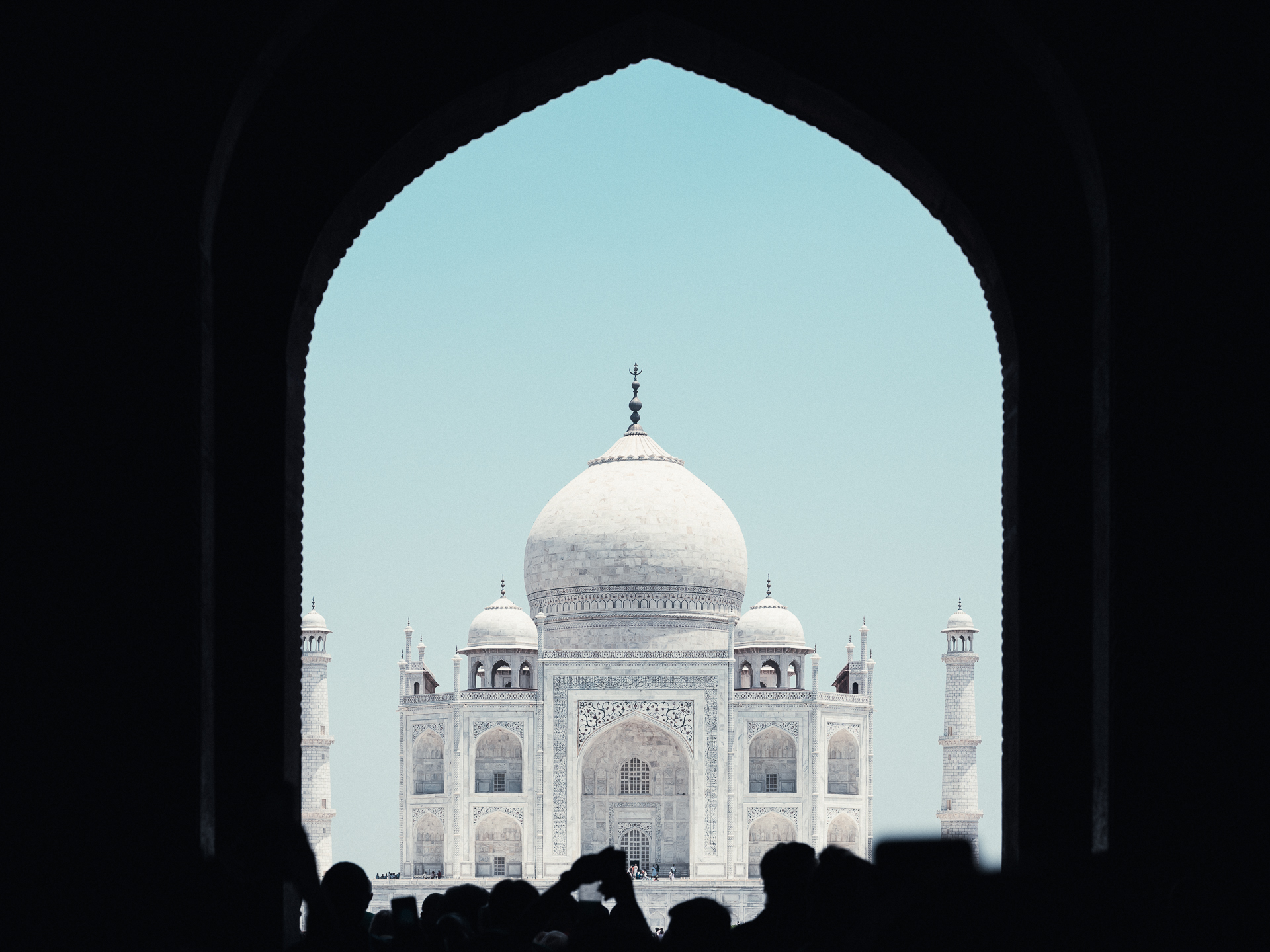
From the shade of the entrance gate, the Taj Mahal appeared inside a dark arch. The silhouettes along the lower edge became part of the photograph. People stopped together before a view they had already seen in pictures, but were now experiencing for themselves.
Outside, the central line of the garden directed every visitor towards the same point. The view was familiar, but standing there made it clear why it had become familiar. The architecture controlled the landscape with remarkable precision.
History with people in it
Back in New Delhi, Humayun’s Tomb offered an earlier view into Mughal architecture. It is one of the important Mughal garden-tombs of the Indian subcontinent. Its central axis, formal garden and water channels anticipate ideas that were later developed further at the Taj Mahal.
The complex is built around order and symmetry, but my photographs became more interesting whenever someone interrupted that order.
Two men pushed a loaded handcart beneath an old tree.
A man climbed from a dark interior into the bright afternoon light.
A woman crossed the open lawn with a broom. Nearby, a dog stood almost motionless in a shallow pool, briefly escaping the heat.
None of these were major events. They were ordinary scenes that returned the historical site to the present. The buildings were not separate from the life around them. They were cleaned, maintained, crossed, guarded and rested beside.
The worn stone showed the age of the place, but the people working and moving around it showed that it was still part of daily life.
Hampi: stone and movement
Travelling south to Karnataka changed the material and character of the journey. Red sandstone and white marble gave way to granite, open sky, farmland and the boulder landscape of Hampi.
Hampi was the capital of the Vijayanagara Empire, once one of the major powers of southern India. Its temples, market streets, water structures and ceremonial buildings now stand among fields, trees and immense formations of granite.
Of all the places on the journey, Hampi came closest to the type of landscape I had hoped to photograph. The ruins, clouds, rice fields and boulders formed a remarkable environment.
It also made the difference between a cultural itinerary and a landscape-photography journey especially clear. We moved through the sites according to a fixed programme, usually during the hardest part of the day. I could not arrive before sunrise, wait for the weather to change or return to the same viewpoint in evening light.
The journey was challenging photographically, but it encouraged me to pay attention in a different way. Instead of waiting for a complete landscape photograph, I collected smaller scenes while moving through the area.
At first, I photographed the architecture. Soon, I became more interested in the human scale inside it: a person walking towards a temple, a woman in red at the end of a pale arched corridor and small gestures made visible by spaces built on a monumental scale.
Virupaksha Temple felt different from the quieter ruins around it because it remains an active place of worship.
A barefoot man carrying a metal vessel walked towards the inner gateway. Three women crossed the courtyard beneath the carved gopuram. The temple was not simply a surviving piece of architecture. It continued through use, ritual and repeated daily movement.
Grey langurs moved through the temple grounds and rested on the warm stone. They appeared completely at home among the visitors, buildings and surrounding hills.
Beyond the monuments
Around Hampi and Anegundi, there was far more to see than the major historical sites.
The roads passed small shops, villages, fields, palms and enormous formations of granite. Around almost every turn, the landscape shifted between cultivated land and boulders that seemed to have been placed there on an impossible scale.
The small roadside shops were filled with colour and daily activity. Women gathered beneath the shade of a tree. Nearby, a woman sat with freshly gathered greens at the edge of the fields.
Some places created the feeling of having travelled back in time. It came partly from the old architecture and traditional work, but also from the pace and atmosphere of the surroundings. The feeling was not that the places had remained unchanged. It was that older ways of living were still visible beside the present.
From the higher ground around Hampi, granite boulders continued across the valley in every direction. They were impressive even in the flat daytime light. In late evening light, with the right weather, the colour and shape of the stone could have become something entirely different.
Below them, flooded rice fields formed precise green lines through the land. The contrast was striking: immense, irregular stone beside fields shaped gradually by work, water and season.
I end this sequence with a farmer preparing the red soil with two oxen while birds follow the newly opened ground.
The scene lasted only a short time as we passed. It contained many of the things I kept noticing throughout the journey: the scale of the land, physical work, animals moving alongside people and a brief period of concentration within a much larger landscape.
What surprised me
One of the most positive surprises was how friendly and curious people were. Strangers often wanted to say hello, ask where we were from or join a photograph. The conversations were usually brief, but they made the journey feel welcoming.
The traffic required a different sense of time. Even a simple journey across a city could take much longer than expected, so extra time was always necessary. The movement often looked chaotic from the outside, yet drivers appeared to understand a rhythm that was difficult for a visitor to read.
The size and variety of India also became clearer as we travelled south. Delhi, Agra, Hampi and Bengaluru did not feel like different versions of one place. The landscape, architecture, weather, food and pace changed noticeably along the route.
The summer heat was intense, particularly during the midday visits. It was manageable with water, suitable clothing and regular opportunities to cool down indoors, but it shaped every day and affected how long it was possible to concentrate outside.
There were also things that were difficult to see. The amount of litter, particularly plastic waste in and around some urban areas, was unfortunate. It stood in strong contrast to the beauty, history and hospitality we encountered elsewhere.
People behind the journey
The places were only one part of the experience.
It was valuable to meet the people who organised and supported the journey, as well as the other invited participants from different European countries. Long transfers, shared meals and days spent moving through unfamiliar places gave us time to talk about photography, media, culture and the different ways people experience a country.
Those conversations became part of the journey, even when they did not appear directly in the photographs.
Closing reflection
What stayed with me was not one monument or viewpoint. It was the relationship between large historical places and ordinary daily life: formal architecture beside physical work, ancient stone next to cultivated land and individuals crossing spaces designed on an immense scale.
I returned to Finland with a wider idea of quiet. It can come from emptiness, but it can also appear for a few seconds in a place that continues moving around you.
The journey was photographically challenging, but it broadened my understanding of India’s culture and history. It introduced me to the country through monuments, cities, temples, villages and official spaces.
I am grateful for that first experience. It also clarified what I would be most interested in exploring on a future visit.
India’s forests, mountains, rivers, coastlines, rural roads, wildlife and changing weather remain almost entirely outside this essay. I would be interested in experiencing places where nature has a stronger role and where there is enough time to work with early and late light, changing conditions and the character of the landscape itself.
That part of India is still waiting for me.
This journey was part of an official familiarisation visit for European content creators, organised and hosted by the Ministry of External Affairs, Government of India. All photographs and reflections are my own.
Photography, licensing and destination collaborations
Selected photographs from this journey are available for editorial, cultural and commercial licensing.
I work with destinations, cultural organisations and responsible travel partners to create considered visual stories shaped by landscape, natural light and a strong sense of place. For licensing, commissioned photography or a future nature and landscape collaboration in India or elsewhere, please get in touch.