Article content
I have photographed many places that looked beautiful in person but did not become strong photographs.
That can feel strange at first. You stand in front of a lake, a forest, a mountain, or an open field and everything seems to be there. The view is beautiful, the light is decent, and the place feels worth photographing. But when you look at the image later, something is missing.
Over the years, I have learned that the landscape itself is often only the beginning. The photograph usually starts to appear when I notice what else is happening in the scene: a small change in light, a line of fog, a distant figure, an animal moving through the frame, the way snow removes distractions, or the way water reflects the sky. Those things can turn a view into a photograph.
For me, taking better landscape photos has become less about finding perfect scenery and more about noticing what gives the scene feeling, direction, and presence.
The view is only the beginning
A beautiful place can make you stop. It can make you take out the camera. But it does not always tell you how the photograph should feel, and that is where the real work begins.
When I arrive at a location, I try to slow down enough to notice what is actually drawing me in. Is it the shape of the land? The way the light falls on one part of the scene? The silence? The distance? The weather? A small detail that feels slightly out of place?
If I do not know what first made me interested, I usually end up photographing too much. I may walk around and make many frames, but the images often feel unfocused afterwards. Not because the place was wrong, but because I had not yet understood what the place was offering.
The question I return to is simple: what is the photograph really about?
Sometimes the answer is not the whole view. It might be one tree, one line of light, one reflection, one patch of snow, one animal, one person, or one feeling that appears only for a short moment. When I start there, the photograph becomes clearer.
Wait for something to happen
Sometimes the best thing you can do is not to move to another location too quickly. A scene may not work immediately. The composition might feel empty, the light might be too even, or the foreground might not lead anywhere. But if the place has something interesting, I often stay with it for a while.
Light changes. Fog moves. Birds appear. A person walks into the distance. Wind changes the surface of the water. Snow begins to cover small distractions. A landscape photograph often needs a small event. Not always something dramatic, but something that gives the viewer a reason to stay in the image.
Fragile came from a small pond on a foggy morning. I walked around the pond for a while first, looking at different parts of the shoreline and into the nearby forest, without fully knowing what the photograph would be. The place felt quiet, but the image was not there yet.
Only when the fog began to thicken did the scene start to open up. The pond looked different. Simpler. More delicate. I found this small tree growing from a rock in the water and waited for the moment when everything around it became quiet enough. What interested me was not only the subject itself, but the way the fog changed the whole space around it. A small pond became something else entirely.
That is often what I mean by seeing beyond the scenery. The place may already be there, but the photograph appears when something shifts. Moments like that have taught me to be more patient with a place. Sometimes the photograph is not hidden in a completely different location, but in the next shift of weather, light, or atmosphere.
Look for the element that carries the feeling
When I say that I try to see beyond the scenery, I often mean that I am looking for the element that carries the feeling. It can be very small: a lone tree making a field feel more silent, a road giving the image direction, a person making a large place feel even larger, an animal bringing life into a still scene, a reflection making the photograph feel more dreamlike, or a small light in the distance changing the whole mood.
The subject does not always need to dominate the landscape. Sometimes it only needs to give the feeling somewhere to land. This is one reason I like simple subjects. A tree, a road, a boat, a rock, a figure, a bird, or a small shape in the snow can hold the image together without explaining everything. The subject gives the viewer a place to begin, and after that, the atmosphere around it can do the slower work.
People and animals can belong in a landscape
I do not think a landscape photograph has to be empty to feel like a landscape. A person, animal, bird, boat, cabin, road, or even a small trace of human presence can make the scene stronger if it belongs to the moment.
A human figure can give scale. It can make the landscape feel vast, lonely, peaceful, fragile, or unknown. An animal can add movement or a sense that the place is alive without needing to explain too much.
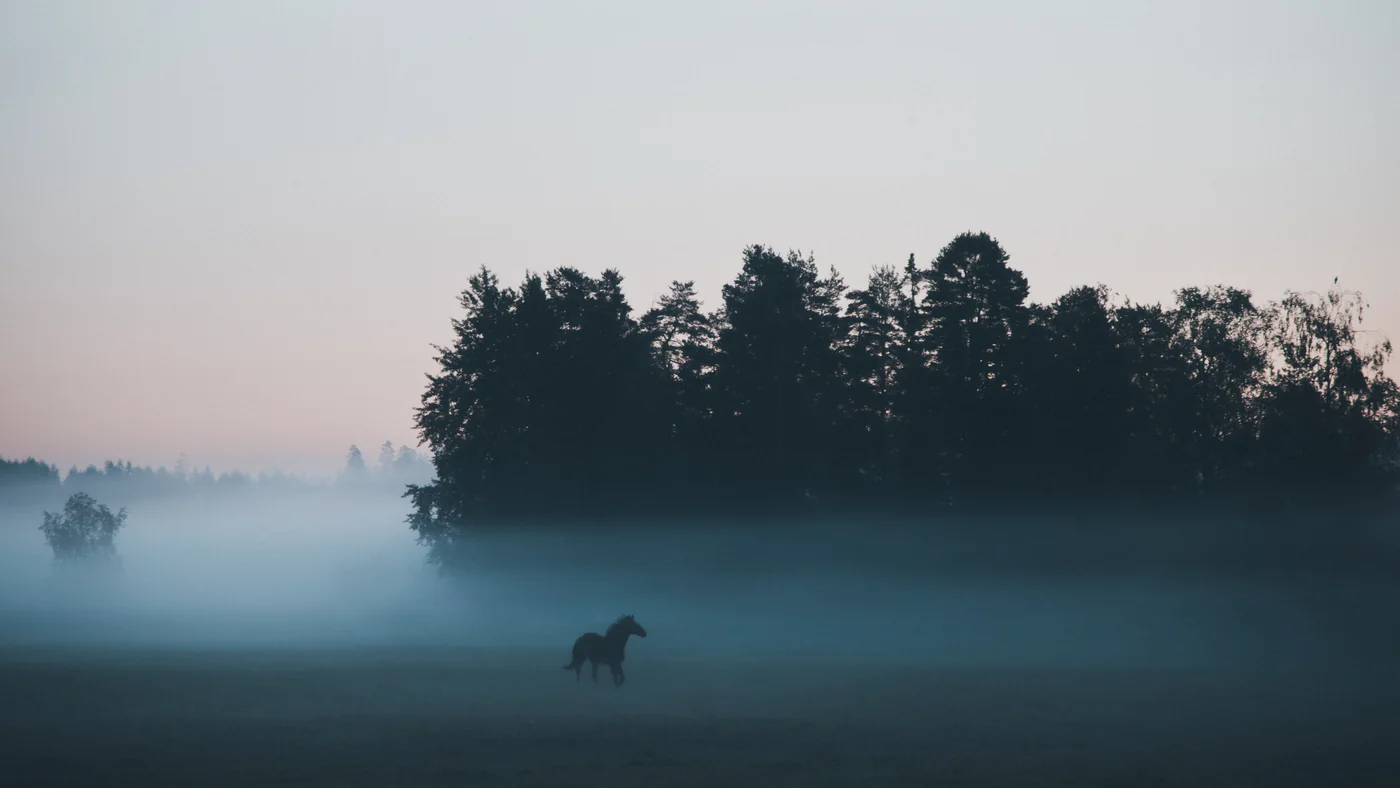
The important part is that the element should not feel added only to make the image more interesting. It should support what the scene already feels like. Free Spirit is a good example of this for me. The early morning mist was already beautiful, but the horses gave the scene another layer. They brought presence into the landscape. Without them, the photograph would have been mostly about weather and light. With them, the image became more alive.
I like moments like that because they cannot be fully controlled. You can place yourself in better conditions, you can watch the light, you can return to a place, but sometimes the final piece arrives on its own. Your job is to notice it when it does.
Let light and weather decide the direction
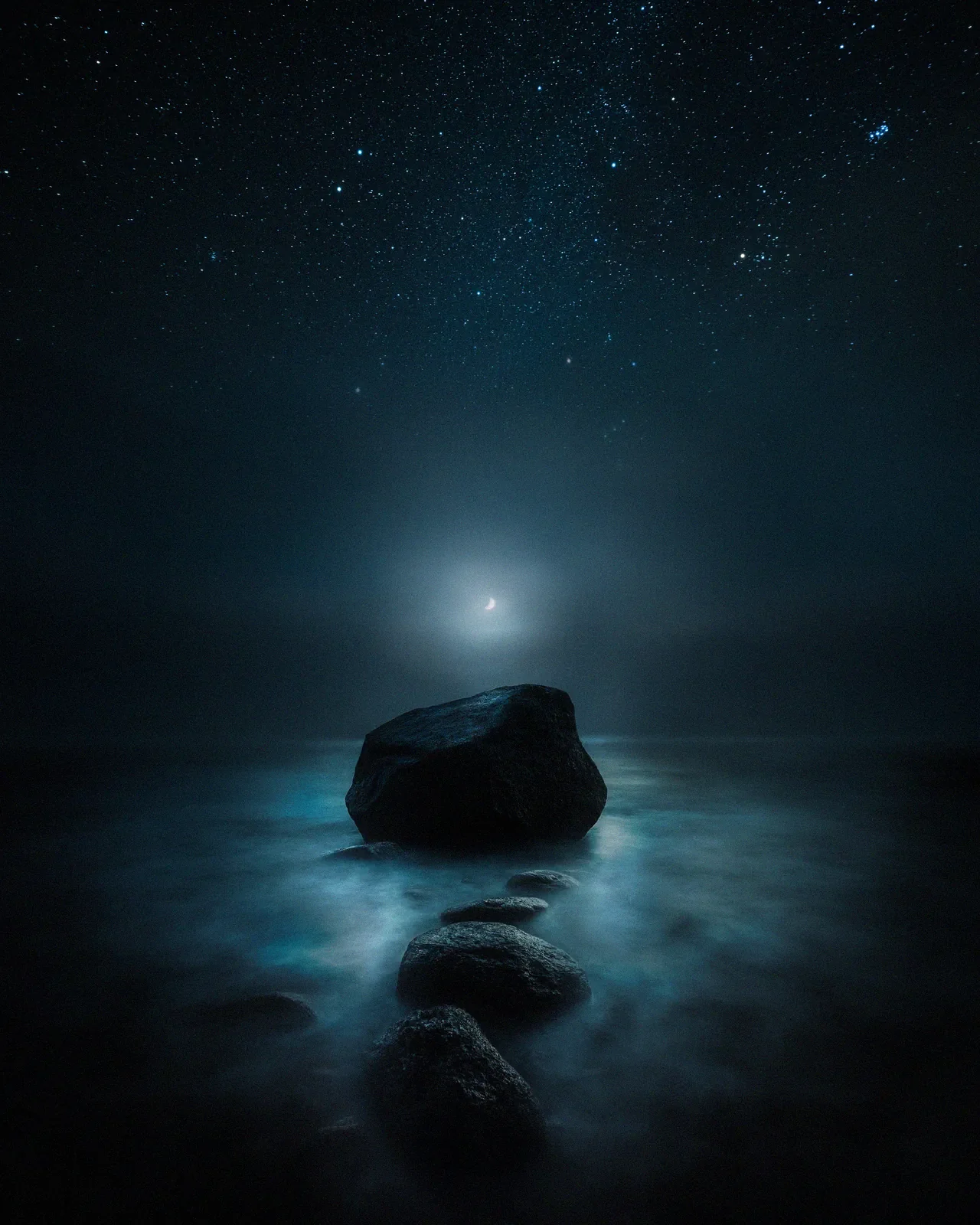
Light and weather often decide what kind of photograph the scene wants to become. The same place can feel completely different in morning mist, summer rain, winter snow, blue hour, harsh sunlight, fog, dark skies, or bright Nordic nights. That is one reason I keep returning to familiar places. I am not only returning to the location. I am returning to see what the light and weather will do to it.
In spring and summer, I often notice softness, reflections, long evenings, bright nights, and small details returning to the landscape. In autumn and winter, the same places can become quieter, darker, simpler, or more graphic. Each season gives a different way to see beyond the scenery.
Snow can remove distractions. Fog can hide the background. Rain can deepen the colors. Wind can create movement. Frost can turn ordinary details into something worth looking at closely. That is why I try not to think only in terms of good or bad weather. Some of my favorite conditions are the ones many people avoid. They simplify the world and make the feeling of the place more visible.
Notice the smaller landscape
Seeing beyond the scenery does not always mean waiting for a dramatic sky or a perfect subject. Sometimes it means looking closer.
Winter’s Grasp is more about texture, shape, and the quiet force of the season than a wide view. The photograph comes from noticing how winter changes the surface of things. Snow, ice, branches, patterns, and small details can create their own kind of landscape.
I think this is important because photographers often search for the bigger scene first. I do that too. But when the larger view does not work, there may still be a photograph nearby. A detail can carry the same feeling as a wide landscape. It can show coldness, fragility, silence, movement, pressure, time, or change. It can also help you understand a place more deeply. Sometimes the small detail is what tells the truth of the whole scene.
Compose around what you noticed
Composition becomes easier when you know what you are trying to protect. If the scene feels quiet, I usually try to remove anything that makes it too busy. If the scene feels lonely, I may leave more empty space around the subject. If the scene feels mysterious, I do not always want to show everything clearly. If the scene has movement, I look for lines, shapes, or light that guide the eye through the frame.
Rules can help, but I try to use them as guides. The rule of thirds, balance, framing, and leading lines can all be useful, but they are not the reason the photograph works. They are tools for supporting what you already noticed.
The more important question is simple: does this element support the photograph, or does it take something away from it? That question has helped me more than many rules. If something weakens the image, I try to change my position, simplify the frame, wait for the moment to change, or leave it out.
Many times, taking a better landscape photo is not about adding more. It is about removing what does not belong.
Edit from the original reason
When I edit, I try to return to the reason I stopped. Was it the coldness of the light, the softness of the fog, the silence of the snow, the shape of the road, the small figure in the distance, or the feeling that the place was almost disappearing? That original reason should guide the edit.
It is easy to make an image more dramatic, more colorful, or more polished. But that does not always make it stronger. Sometimes the photograph only needs a few careful decisions so the feeling becomes clearer.
If the scene was quiet, the edit should not make it too loud. If the scene was soft, the contrast should not destroy that softness. If the image was about distance, the edit should keep that sense of space. If the subject was delicate, the processing should not overpower it.
This is also one of the reasons I created resources like the Atmosphere eBook and my editing courses. I wanted to share a process that is not only about settings, but about making choices that support the mood, color, light, and direction of the image.
Editing is where the photograph becomes more intentional. But for me, the best edits still feel connected to the moment when I first stopped and thought, there is something here.
Create photographs that can be returned to
A good landscape photograph does not always need to reveal everything at once. Some images become stronger slowly. You return to them because of the space, the mood, the color, the silence, or a detail you did not notice at first.
That is also what I think about when an image becomes part of a series, a portfolio, or eventually a print. A print has to live longer than the first impression. It has to hold a feeling quietly, in a real space, on different days and in different light.
For me, that usually comes back to the same thing: the image needs a clear feeling behind it. It does not have to be dramatic. It does not have to show everything. It does not have to come from a famous location. But it should have a reason to exist. Something in the image should make you want to stay with it a little longer.
Final thoughts
The landscape gives you the starting point, but the photograph often appears when you notice what else is there. Light. Weather. Scale. Movement. Silence. A subject. A detail. A feeling that only exists for a short time.
If you want to take better landscape photos, try not to hurry past those things. Walk around. Wait. Look closer. Ask what first made you stop. Ask what the scene feels like. Ask what needs to stay and what can be left out.
A view can be beautiful. But the photograph begins when the scene starts to mean something.
The complete working system
Complete Bundle
You just read about noticing what turns a view into a photograph. The Complete Bundle is where that noticing becomes a repeatable process — the presets, courses and guides behind it.
- The Phase, Saga and Fine Art preset collections
- The Borealis aurora presets
- The Star Photography Masterclass and Composite Photography course
- The Atmosphere guide