Landscape Photography in the Age of AI
Contents
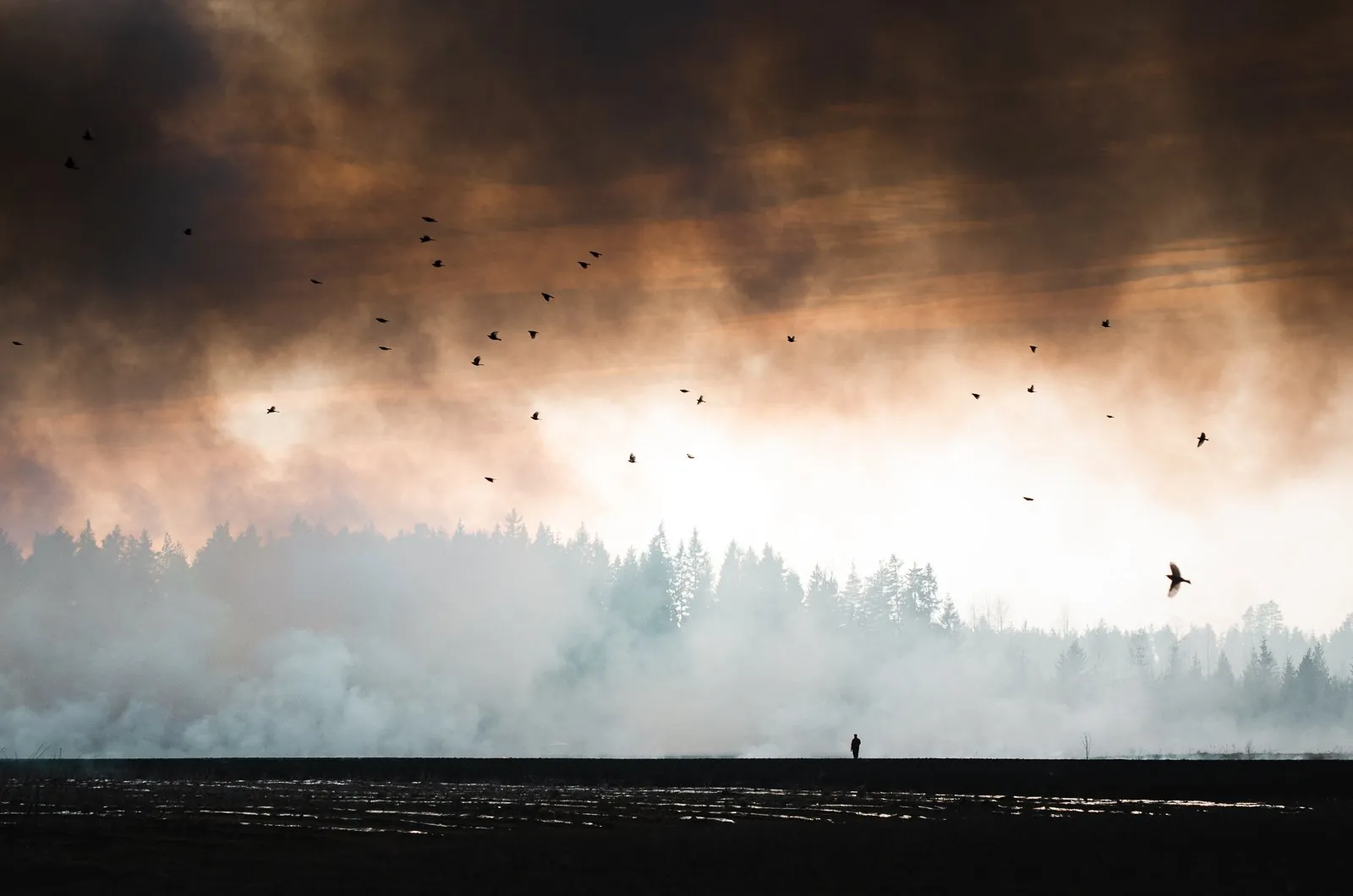
In 2012, I was on my way to photograph the sea when I noticed a large cloud of smoke in the distance. I changed direction and drove towards it.
I ended up beside a field where a controlled burn was taking place. There was a man standing in the middle of it, taking pictures, and birds were flying through the smoke. For a brief moment, they were exactly where I wanted them in the frame.
That photograph became Still Standing. I still find it hard to believe it was a single exposure. I had set out to photograph something completely different.
Lately, when I see how convincing AI-generated landscapes can look, I find myself thinking about that day. I could describe the field, the smoke, the man and the birds to an image generator. It might make something beautiful. But I would never have thought to make that particular picture if I hadn’t seen the smoke and followed it.
The hours behind one photograph
Underneath The Surface was almost the opposite experience. I went to Kuusamo with a particular photograph in mind, but I had no idea whether I could actually make it.
I was trying to photograph the northern lights from the water, with part of the camera below the surface. On the first attempt, the wind disturbed the water and the sky clouded over. After three hours in the cold, I came away without what I had hoped for.
On another attempt, the northern lights finally appeared for a short time. I took the frame above the water, then photographed the submerged log below it. Later I combined those two exposures. Both were made in the same lake, during that shoot.
I remember the failed attempts as clearly as the moment the lights appeared. I remember being there in the cold, hoping the conditions would change and not knowing if they would. The finished photograph is only a small part of what that experience was like.
I wrote more about the attempts, the camera setup and the editing in Behind the photography: Underneath the Surface.
The mornings I couldn’t have planned
Not all my photographs take that much preparation. Some of my favourites have come from noticing something unexpected close to home.
One winter morning in Järvenpää, after a cold and windless night, mist was rising from the lake. I hadn’t planned a shoot, but I had my camera with me. The fog was hiding most of the surroundings, leaving a small group of frosted trees visible. I stayed and waited as a person walked from the frozen lake towards the trees.
I called the photograph In the Mist. What interested me was how different this familiar place had become. The trees were always there. The fog and that small figure gave me a way of seeing them I hadn’t seen before.
This is a large part of why I keep returning to the same places. I don’t always have a picture in mind. Sometimes I just want to see what the weather has done to a landscape I know.
How I want to edit my photographs
I have never seen editing as something separate from my photography. The RAW file is a starting point. I work with colour, contrast and light to bring the image closer to the atmosphere I remember.
In Vík, Iceland, I photographed the sea stacks beneath low clouds. A fulmar flew through the scene as I pressed the shutter. The RAW file was quite flat, with a yellow-grey sky. When I edited it, I darkened the sky and rocks, worked on the light around the bird and adjusted the colour to bring out the mood I felt standing there.
You can see the full process in my Vík case study. I’ve also written about Cinematic Color Grading, and the same approach to colour and tone runs through my EPIC Presets.
I know that tools using machine learning can help with masking, noise and other technical parts of editing. I’ve written about some of those AI editing tools before. To me, that is a different question from generating the content of a photograph.
I don’t use generative AI to create my photographs or to add things that weren’t there. That is a choice about my own work, not a rule I think everyone has to follow. I enjoy the editing process, but I want the landscape, the weather and the things I noticed there to remain the starting point.
Why I still want to go outside
I thought about this while working on The Human Prompt, a campaign for Nikon Europe where five creators responded to the same brief by making photographs in real locations. I made my part in Lapland, working with the light and conditions we had. You can find more about the campaign in Projects.
But I also know that technology isn’t the only thing that can pull me away from what I enjoy about photography.
In 2019, I took more than six months away from photography and social media. I had become caught up in posting, checking reactions and thinking about how my work would be received. It had started to affect how I felt even when I was out with my camera. Eventually I stopped enjoying photography.
During that break I realised how much I missed simply following my own interest. I didn’t want to make photographs because I needed something to post. I wanted to feel inspired to go outside again. I wrote about that time in What I learned after six months off from photography and social media.
I think that experience has something to do with how I feel about AI images now. It would be easy to spend a lot of energy comparing what I make with what a machine can produce. I’ve already learned what happens when I let those comparisons take too much space.
In October 2017, I went back to a lakeshore in Järvenpää that I had photographed hundreds of times. That day, the first snow was falling. The dark water, white shore and a solitary tree looked different from anything I had seen there before. I stayed and waited for the scene to come together.
The image became First Snow. When I look at it now, I remember that morning and how surprised I was by a place I thought I knew so well.
I don’t know what images will look like in a few years or how people will value them. I still want to go out with my camera, return to familiar places and occasionally come home with something I couldn’t have planned.
Some of these photographs are available as fine art prints.
Continue reading

Behind the photography: Underneath the Surface
The story of Underneath the Surface: standing neck-deep in icy Lapland water at night to photograph the northern lights, and how I made the image.

Cinematic Color Grading in Lightroom: Creating Atmosphere
How I use Lightroom's Color Grading tools, cool shadows and a touch of warm light to shape atmosphere in landscape photographs, with real examples.
The Best AI Image Editing Tools for Landscape Photographers (2026 Update)
An October 2026 update on the AI tools I wrote about in 2023, organised by photographic problem: noise, sharpness, print size, masking, colour and keeping the result natural. Product facts are sourced, my own experience is dated and generative features are marked.